
Nation
Borno, UN Host High-Level Donor Visit To North-East

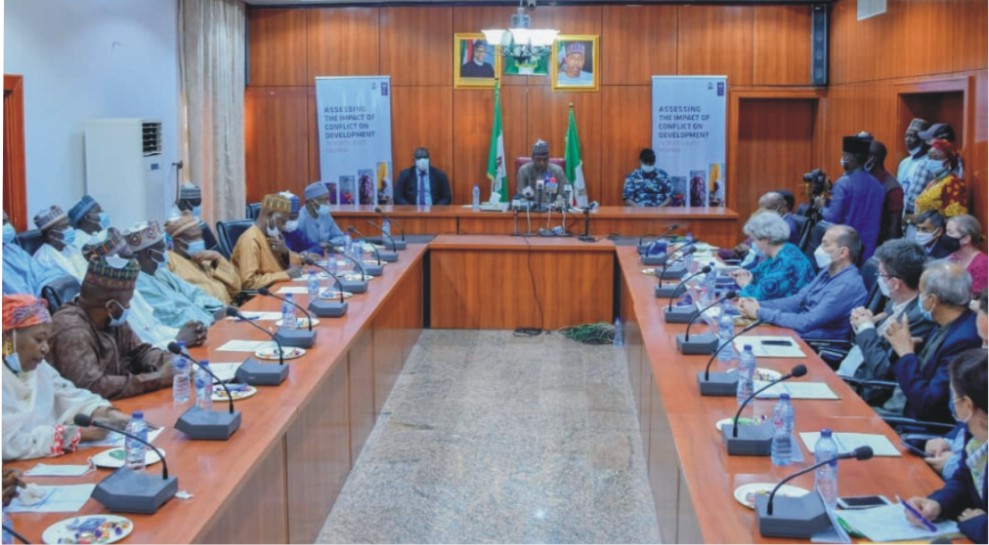
The Borno State Government and the United Nations hosted a high-level delegation of key partners during a one-day mission to Borno State, last Friday, to highlight humanitarian and development priorities in the North-East.
During the visit, delegates from Canada, the European Union, France, Germany, Norway, Switzerland, the United Kingdom and the United States of America as well as the World Bank Group and International Monetary Fund (IMF) visited key locations, and were provided an overview of the coordination and operational challenges related to humanitarian and development programming in the region.
The objective of the high-level visit was to underscore development deficits in the three states of Borno, Adamawa and Yobe, and to put a spotlight on humanitarian needs, particularly with regard to access for service delivery, security, and the rapidly escalating food insecurity.
The mission included two parallel visits to Banki, Bama LGA as well as Maiduguri in Borno State.
In Banki, delegates visited and met with key partners and beneficiaries from the United Nations Development Programme (UNDP) Regional Stabilization Facility.
The high-level delegation discussed the ongoing insecurity in the region, and how the protracted conflict in Nigeria has affected the Lake Chad region, including its neighbouring countries of Cameroon, Niger and Chad for over 10 years.
As a result, over 3.2million individuals are displaced, with 4.4million food insecure people at crisis and emergency levels and millions of civilians subjected to extreme hardships.
In the North-East alone, 13.1million people live in areas affected by conflict, out of whom 8.7million are in need of immediate assistance.
The security situation remains highly volatile with non-state armed groups (NSAGs) continuing to target communities as well as humanitarians, including in areas that were previously considered secure.
Delegates were able to visit the Banki IDP camp and the newly constructed police station and customs office on the border of Cameroon to learn how development efforts were increasing security and supporting the return of normalcy in the community.
Led by the Borno State Governor, Prof. Babagana Zulum, with support from the UN, the mission also provided an opportunity to advocate for humanitarian and development efforts, emphasize the protection of civilians in the context of a challenging and insecure operating environment, and highlighted operational efforts in restoring the dignity of conflict-impacted communities through a people-centred approach paired with durable solutions.
In addition, the delegation discussed the urgent need to scale-up initiatives around food security, nutrition, protection and livelihoods for impacted populations in desperate need.
“Here in the Lake Chad region, we face one of the most severe humanitarian emergencies in the world. The uncertainty arising from the conflict is hampering normal life making dependency on humanitarian assistance a necessity but an unwarranted norm”, Zulum said.
“While we thank our committed international stakeholders for their strong partnership and generous contributions to the stabilization of the North-East, I urge for continued support from all partners to continue to join us, whole-heartedly, in taking bold steps to promote development in the region”.
In Banki, delegates visited and met with key partners and beneficiaries from the United Nations Development Programme (UNDP) Regional Stabilization Facility (RSF), which uses a community-level approach to enhance physical security and access to justice, rehabilitate essential infrastructure and basic service delivery as well as revitalize the local economy to help communities recovering from conflict build back better.
The Resident Humanitarian Coordinator, United Nations Nigeria, Edward Kallon said, “On behalf of the UN system, I wish to extend a deep sense of appreciation to our international partners for their continued support to the government and people of the BAY states as well as the Lake Chad region.
“The mission today has shown the power in combining development and humanitarian efforts, and it is clear that we must accelerate these contributions and find innovative ways to end this decade-long conflict if we are to meet our global, national and state goals to build back stronger”.
Delegates were able to visit the Banki IDP camp and the newly constructed police station and customs office on the border of Cameroon to learn how development efforts are increasing security and supporting the return of normalcy back in the community.
In addition, delegates were able to have a dialogue with the community-led Stabilization Committee and returnee representatives to hear first-hand from the community about their needs and challenges.
In Maiduguri, delegates had the opportunity to meet with members of the displaced population, and key humanitarian actors, who lead the various sectors of response.
The free-flowing discussions with the delegation were led by Deputy Humanitarian Coordinator, Vincent Lelei, and brought focus to priority concerns of the humanitarian community, as it relates to access, security, protection, freedom of movement and the potential impact of catastrophic food insecurity.
During the visit the United Nations Office for the Coordination of Humanitarian Affairs (OCHA) took the delegation to Muna IDP camp and the Stadium IDP Camp, engaging with IDPs and partners who are supporting the two camps.
Delegates also met at the governor of Borno’s office to have a dialogue with key government actors as well as participate in the launch of a new UNDP report, ‘Assessing the Impact of Development in North-East Nigeria’ which looks at the impact of conflict on development in the BAY states.
In her remarks, the Head of Cooperation of the EU delegation to Nigeria and ECOWAS, Ms Cecile Tassin-Pelzer, said, “Today’s high-level visit to Borno State, including Banki, has been a great opportunity to reassert the EU and the international community support to the implementation of the Lake Chad Regional Stabilization Strategy.
“To date, the EU and its member states have committed around €56million through the UNDP Regional Stabilization Facility. This is a concrete illustration of Team Europe’s contribution to the stability of Nigeria and the wider region”, she added.
As communities attempt to recover, resilience can only be built when both humanitarian and development efforts are combined through the humanitarian-development peace nexus.
While root causes of the conflict are many and varied, priority must be given to address these challenges.
This high-level visit provided key donors with the opportunity to gain an in-depth understanding of the urgent need for continued support to assist conflict impacted communities in North-East Nigeria recover.
Also speaking, the British High Commissioner to Nigeria, Ms. Catriona Laing, said, “I am glad to have had the opportunity to visit communities in Borno and meet with Governor Zulum to understand the situation on the ground. It is vital we ensure the safety and dignity of displaced people, act now to tackle worsening food insecurity, and support stabilisation efforts.
“The UK is providing a comprehensive package of support to the region, including lifesaving humanitarian aid for conflict-affected people and support for the Regional Stabilisation Facility”.
“We are grateful to our partners on the ground who directly implement programmes made possible through U.S. humanitarian assistance totaling over $1.45billion over the past 6 years. There is no substitute for seeing and hearing from local residents and displaced families who are finding ways to live under the most austere conditions” the U.S. Ambassador to Nigeria, Ms. Mary Beth Leonard, added.


Concerned Rivers Chiefs For Peace And Development has said it formation was not politically motivated or has any links to political parties or candidates.
The group which said this at a media briefing at Abuloma in Port Harcourt City Local Government Area said it’s formation has nothing to do with politics.
According to the text for the briefing jointly signed by Chief Boma Kele Oyika it’s chairman and Chief Inemo T Ikama Deputy Secretary General said the organization is expected to focus on conflict Resolution, community engagement, collaboration with government and private sector actors
‘it mandate also includes promoting peace building initiative, supporting local economic empowerment programms and strengthening traditional institutions in our state and beyond as partners in governance ”
It said the body is led by a team of respected traditional leaders serving as trustees
“Their collective leadership reflects a blend of experience cultural authority and grassroots connection
“Key elements considered vital for addressing long standing,socio economic and security challenges in the region”
The release further says ” the formation of this organization comes at a time when communities in Rivers state continue to navigate between issues ranging from youth unemployment, environmental concerns and intermittent conflicts amongst the traditional rulers and beyond
“By bringing together influential traditional figures under a unified platform, the group aims at serving as stabilizing force while advocating for inclusive development policies ” it said
It also described its emergence as a new chapter in grass roots leadership and regional development
Earlier, chairman of the body, Chief Boma Kele Oyika said the organization will work with relevant authorities to promote peaceful coexistence in the state, reduce crime and promote economic development.
He said it is open to all Chiefs from the 23 local government areas.
The Chairman of The Nigeria Delta Chamber of Commerce, Trade, Mines and Agriculture NDCCTMA,Ambassador Idaere Gogo Ogan and the Managing Director of the Niger Delta Development Commission ( NDDC ) Dr Samuel Ogbuku have challenged Niger Delta entrepreneurs to close the gap in Gross Demostic Products (GDP) differences between the region and that of the South Western part of the country by coming home to invest.
The two leaders spoke at a business round table organized by NDDCTMA in Port Harcourt
Chairman of NDDCTMA Ambassador Idaere Gogo Ogan, said to close the gap between the south west region which he said has a GDP seize of about #59 trillion and that of the Niger Delta which is about #34 trillion was to massively invest in the region.
He said no other persons can do this except sons and daughters from the region.
“For me I believe in statistics,I believe in data and everyday I looked at the data concerning development in Nigeria and from the GDP point of view, the South West has #59 trillion, that is the seize of the south west region economy, the second region following them is the Niger Delta region with GDP seize of #34 trillion,so there is a yearning gap of #25 trillion that separates the south west and the Niger Delta region, that is why we are here”
Ogan said the region has the capacity to close the gap and even surpassed it but regretted that indigenes of the region have chosen to ignore it in terms of investment.
“We need to close that gap .If we close that gap and even surpassed it,all the negative problems of militancy and unemployment will automatically erase “he said
Ogan said the event was organized to remind the people that past efforts of militancy and agitations have not led the region to any where
“That is why we are gathered here in this room “he said.
Also speaking Managing Director/Chief Executive officer of the Niger Delta Development Commission( NDDC) Dr Samuel Ogbuku urged indigenes of the region not to use the problem of insecurity as an excuse to continue to deny the region of investment as every part of the country have in one time or the other experienced crisis.
Ogbuku said most indigenes have displayed high level of unpatriotism towards the region by taking investments that would have benefited the people to either Lagos or Abuja.
“With little threat we have left the city,we have gone to Lagos,we have moved our families to Abuja and Lagos
“If you go round GRA all the property, you will see,”to let to let”most of them are now empty “he said.
The NDDC MD said despite the fact that people from the region are doing well in the oil and gas, banking and other sectors, its impact are not being felt at home because they are stationed outside the region.
He said time has come for potential investors from the region to have a change of heart by coming home to invest.
John Bibor

The Nile University of Nigeria has successfully hosted the maiden National Conference of the International Communication Association (ICA) Nigeria Chapter, drawing scholars, policymakers, and media professionals to examine emerging global communication trends and Africa’s positioning within them.
The two-day conference, themed, “Global Communication Shifts and Implications for Africa,” took place from March 24 to 25, 2026, at Nile University of Nigeria in Abuja. The event marked the first national gathering of the ICA Nigeria Chapter since its inauguration in March 2023, making it a historic milestone for communication scholarship on the continent.
Delivering a welcome address on behalf of the Vice Chancellor of Nile University, Prof. Dilli Dogo, the Head of Mass Communication Department, Dr. Jacob Suemo, described the conference as a “clarion call to reimagine Africa’s place in the global communication landscape,” emphasising the institution’s commitment to academic excellence and innovation.
The conference convened leading international scholars, including ICA President, Prof Thomas Hanitzsch and REACH Committee Chair, Prof Noshir Contractor, alongside other notable academics such as Prof Srivi Ramasubramanian, Dominique Brossard, and Prof. Raka Shome. Representatives from ICA chapters in India, Indonesia, and Kenya also participated, reinforcing the global outlook of the gathering.
Participants engaged in keynote sessions, panel discussions, and paper presentations addressing critical themes such as artificial intelligence, climate change communication, media systems, governance, and digital transformation. These discussions reflected the broader aim of the conference to interrogate how global communication shifts affect African societies, institutions, and development pathways.
A key highlight of the conference was a strategic panel session titled, “Is Africa Ready for ICA26?” which assessed the continent’s readiness for deeper global engagement ahead of the ICA International Conference scheduled for June 2026.
The event featured over 50 research presentations from scholars across Nigerian institutions, showcasing diverse perspectives on communication research and practice. It also attracted major stakeholders in government and media, including representatives of the Federal Ministry of Information and National Orientation, the News Agency of Nigeria, and the Nigeria Press Council. Discussions underscored the importance of strategic communication in national development and Africa-driven narratives in global discourse.
A major outcome of the conference was the leadership transition within the ICA Nigeria Chapter. Professor Desmond Okocha emerged as the new Chair, succeeding the founding Chair, Dr. Ekaete George. The transition was described as a step toward consolidating the association’s growth and expanding its influence across Nigeria’s academic and media landscape.
Organised in collaboration with academic institutions including Bingham University, University of Cross River State, Nasarawa State University, and the University of Calabar, the conference also featured participation from the West Africa Broadcast and Media Academy (WABMA) as a partner and sponsor.
The ICA Nigeria Chapter noted that the conference provided a vital platform for intellectual exchange, collaboration, and policy dialogue, positioning Nigeria as a key player in global communication research and practice.
The second edition of the ICA Nigeria National Conference is scheduled for March 2027, building on the success of the inaugural event.
-
Opinion5 days ago
Ozoro Festival: Tradition or Tyranny?
-
News2 days ago
Decentralizing Pipeline Surveillance Poses Greater Dangers To Niger Delta …. Group Warns
-

 Politics2 days ago
APC Resumes Electronic Membership Registration Nationwide
-

 Rivers2 days ago
Court Rules Out Interim Administration In Jumbo House, Bonny
-
Politics5 days ago
RIVERS WOMEN RALLY SUPPORT, CONTINUOUS PRAYERS FOR TINUBU
-
Politics5 days ago
AKPABIO, DIRI, OBOREVWORI, OTHERS VOW TO REELECT TINUBU …AS GIADOM RETAINS APC ZONAL CHAIR
-
 Business2 days ago
33 Banks Raise N4.65tn As Recapitalisation Ends
-
Politics5 days ago
Viral 2027 Nomination Forms Price List Fake, Misleading – APC